Dear partners and friends of the Heinrich Böll Foundation,
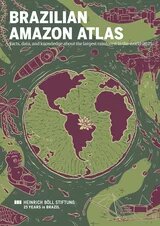
In 2025, we launched the Atlas of the Brazilian Amazon in Belém, Rio de Janeiro, during COP30, at universities, in indigenous communities, and also in Germany. The Atlas is, above all, a platform to amplify the voices of the Amazon. It is a publication written primarily by authors from the region itself. It contains 32 articles that articulate knowledge, data, ancestral wisdom, and science to showcase the forest and its peoples from their own perspectives. By challenging colonial logics of knowledge production, the Atlas opens avenues for thinking about climate solutions that are both sustainable and just for the territories and their peoples.

In 2025, we launched the Atlas of the Brazilian Amazon in Belém, Rio de Janeiro, during COP30, at universities, in indigenous communities, and also in Germany. The Atlas is, above all, a platform to amplify the voices of the Amazon. It is a publication written primarily by authors from the region itself. It contains 32 articles that articulate knowledge, data, ancestral wisdom, and science to showcase the forest and its peoples from their own perspectives. By challenging colonial logics of knowledge production, the Atlas opens avenues for thinking about climate solutions that are both sustainable and just for the territories and their peoples.
Another important milestone of the year was the launch of the Positive Futures Project, an initiative of the Heinrich Böll Foundation in partnership with the Goethe-Institut and Visão Coop. The project aims to connect local experiences of Böll's partners in more than 30 countries that inspire global transformations—real stories of communities cultivating hope and concrete action in the face of the challenges of our time. The Positive Futures Map is more than a digital platform: it is an anti-dystopian manifesto, a living space where possible futures take shape and gain visibility. The first initiatives are already being included, and the map will continue to grow to strengthen connections and exchanges. Learn more here.
In August, we were in Brasília with our partners Lapin and Joio e o Trigo at the 1st Seminar on Artificial Intelligence, Environment and Socio-environmental Justice. Before that, we promoted the Meeting of Worldviews: – Artificial Intelligence and Indigenous Peoples, a space for listening and exchanging ideas with indigenous leaders. The seminar brought together activists, researchers, civil society organizations and other political actors to discuss the impacts of artificial intelligence on ecosystems, territories and ways of life in Brazil. We started from the point of view that technologies are not neutral: they incorporate political choices and can both reproduce and deepen inequalities — which is why this debate necessarily needs to include the environment.
In São Paulo, through a partnership between Böll's Buenos Aires and Rio de Janeiro offices, we supported Latina: International Meeting of Independent Media, organized by Mídia Ninja. Latina was a meeting point for communicators, activists, journalists, artists, and collectives from the Global South who are on the front lines of the struggles for climate justice, democracy, and digital sovereignty. It was also a platform for collaborative coverage by independent media for COP30.
And then we arrived at COP30 in Belém. The people of Pará welcomed the world with a generosity of Amazonian proportions. The Heinrich Böll Foundation was directly involved in more than ten activities—a true marathon. But this intensity opened a vast window of learning. These were enriching encounters, interspersed with the flavors of jambu, filhote fish, tapioca, and açaí. We strengthened ties with partners from across Latin America and India, discussed city models, promoted dialogues between technopolitics and socio-environmental justice, and, with a gender perspective, reinforced demands for a just transition that respects territories. We are delighted to highlight our partnership with Mídia Ninja, fundamental in amplifying voices and narratives.
We also promote debates that connect artificial intelligence, mining, and climate—topics that, at first glance, may seem distant, but say a lot about the future of Brazil and the world. Thinking about socio-environmental justice today requires understanding how technological advances impact populations and ecosystems—and how we can build other relationships between technology and society, between humans, non-humans, and nature. On the banks of the Guamá River, at the People's Summit, we were with the Permanent Campaign against Pesticides in the Berta Cárceres Tent to affirm that defending the climate is also defending clean land and water.
The biggest challenge of the year was—and continues to be—connecting territorial processes to global agendas, making these experiences visible and politically relevant. We know that you have also followed similar paths, and we will be very happy to exchange lessons learned at our upcoming partners' meeting in March.
Looking ahead, 2026 is shaping up to be a complex year. With elections for deputies, senators, governors, and president of the Republic, in a scenario of growing far-right movements in several countries, it will once again be essential to think and act within global networks. In this context, we hosted the recording of a special episode of the Tecnopolítica Podcast in Rio, with Sérgio Amadeu and Marcelo Alves, from Democracia em Xeque. Over more than 200 episodes, the podcast has established itself as a critical and accessible guide to understanding the relationships between power, technology, and politics. In this episode, we discuss disinformation, the power of big tech companies, and the machinations of the far-right. The content is an excellent starting point for thinking about what's to come. You can listen and watch it on Spotify and YouTube — and the project has also become a book.
In this same field of reflection, we launched the publication “Democracy Under Pressure: reflections on the far right with the keys to the past, present and future”, with the participation of Coding Rights, Democracy in Check, journalist Andrea Dip and historian Odilon Caldeira Neto. The publication is free and can be downloaded from our website.
Thankfully, we are not alone. We have each other. And facing collective challenges, when done in partnership, can also be a source of joy and meaning 🙂
For this time "between the years," we wish you peace, rest, and happiness. We are deeply grateful for the partnerships, collaborations, and shared paths throughout 2025.
From today, our team will be on holiday break. We will return on January 5 with renewed energy.
With warm wishes,
Regine Schönenberg
and the Heinrich Böll Foundation team